Monday, January 14, 2008

Mobilians International Partners With PaymentOne to Provide Phone-Based Payment Solution


Mobilians International, the online and mobile payments innovator, announced that it has signed an agreement with PaymentOne Corporation, one of the world's fastest growing online payment service providers (PSPs) and a leader in alternative payments, to provide PaymentOne’s PhoneBill™ payment service to Mobilians’ merchants. Through this new partnership, Mobilians International’s merchants can reach over 150 million U.S. consumers, providing them the option to conveniently charge digital goods and services to their existing broadband and landline phone accounts. “Mobilians is excited to offer this new payment offering to our merchants as we continue to expand our U.S. operations,” said Pragnesh Shah, president and chief executive officer of Mobilians International. “This represents the first phase in launching our payment platform in the U.S. and fully commercializes the core infrastructure of our alternative payments gateway.” “This unique partnership opens new doors for PaymentOne as we seek to expand our base of merchants using the PhoneBill™ product,” said Joe Lynam, chief executive officer and founder of PaymentOne. “Mobilians International, and its majority investor Mobilians Co. Ltd. of South Korea, bring proven success and expertise in phone-based alternative payments and merchant acquisition. This agreement represents opportunities for future partnerships to develop a global payment gateway alliance between our companies.”

An Intro to Neopets Premium


Some info about Neopets Premium: It's cheap. Only $8.00 a month! And less if you pay for it yearly. If you use a credit/debit card, it is conveniently deducted every month without you having to do anything. There is also a FREE 15 day trial. If you don't like it, just cancel by the time the trial is up. Canceling is easy...but who would want to? Every Friday, you will receive a FREE space faerie scratch card after you sign up. And it isn't like the other scratch cards, you'll ALWAYS win. You also get 1000 neopoints for every month that you keep the service. You can also refer people to Neopets Premium to receive prizes such as neopoints, paint brushes, codestones, avatars, and many other amazing things.. You also get the Super Shop Wizard! If you like to buy things DIRT CHEAP, this is perfect for you. The SSW shows you the cheapest things on the site. For example, if you type in "White Paint Brush" the s.s. wizard will show you the cheapest ones on the entire website, instead of searching through parts of the site, like the traditional shop wizard does. These are not the only cool things you get with Premium, there are many more... of course!

Want to Launch a Mobile Virtual World?


MoiPal's CEO Joakim Achren tells you how and why you should! www.worldsinmotion.biz/2007/10/virtual_worlds_conference_iron.php "It seems that mobile connectivity to virtual worlds is right on the horizon. But what about a virtual world actually self-contained in a mobile phone? At the 2007 Virtual Worlds Conference, Ironstar Helsinki CEO Joakim Achren demonstrated and discussed MoiPal, his company's mobile virtual world that works on basic Java handsets. "The idea was like, your friend in the phone," Achren said. "It’s an avatar that lives in your cellphone." The mobile pal is controlled like a Sim, or a Tamagotchi. Achren explained that he got the idea from thinking of how adults have facebook and kids and 'tweens have Club Penguin -- but what about teens? "They are usually not at home, but they always have a mobile phone with them," Achren noted. "And they usually have the best phones. It is a means of self-expression, like ringtones. But self expression should be more than just ringtones." Achren did say that, as it happens only during idle time, gaming and social networking on a mobile platform still have to integrate with a website, especially since mobile phones have such restrictive memory. "Concentrate on using the mobile to do something simple and realistic," he advised. "You can’t just take Second Life and put it on a mobile -- except for Japan, maybe,” he joked. “It has to be a personality extension... and it has to be free,” Achren continued, noting it's not generally a good idea to aim a subscription-based service to kids, since they probably won't even try it. Incentivizing free content is a much better method, he said. Moreover, there are a lot of possibilities for the mobile platform. Achren highlights simple 2 or 3-dimensional content items that can be created on a phone without challenging the memory restrictions. There's also social networking. "You’ve seen Facebook on a mobile. It works pretty well," Achren said. “Mobile gaming is here to stay, so why not think of mobile when it comes to virtual worlds?” He added.
Successful apps have to be client apps. For Western countries the handsets really allow for just text, but Java handsets can be adopted by just about all phones. Achren noted that Flash is becoming more prevalent on handsets, so it may be handy in the future, but for now, "Java is the way to go," especially since Java code translates easily between a mobile phone and a PC. It also needs to use very little wireless data -- less than 1 megabyte, according to Achren. "It can't be a 100 dollar phone bill every month," he noted. Achren described his company's own experience. In 2005, they had developed their own mobile game engine, and they wanted to do something special with it. The pet aspect was a good fit, because it was simple -- you feed the avatar and play games with it, without the need for a network connection. Users can stream their stats to the server, but it's not required. There are also elements of adventure gaming involved. "That’s how we thought of the world, a world with a lot of things to do, not just standing around and talking.” So MoiPal incorporated missions, pre-scripted events, and a narrative.
Most notably, MoiPal is persistent. "Even when you’re sleeping, your pal is doing something," Achren says. The avatar can travel on its own to a virtual city, and upon returning will report to the user about its adventures. "When you wake up in the morning, on the bus you can see what your pal has done and send him or her to do something else while you’re at school," Achren explains.
The website acts as an extension of the world. "It gives you a godlike view of what's happening," Achren explains. Through the website, users can see what others are doing with their pals, their decorations, clothing choices and other game elements. There's even a version of the mobile game available on the website in a pop-up window, for those users who can't play the game on their phones. The content is monetized directly, through virtual goods that can be obtained through a variety of payment options like SMS, PayPal or a credit card. Users can buy gaming extensions, decorative items and other content bonuses that provide better equipment and resources. There are also indirect monetization models, like sponsorships, advertising and product placement. "Ringtones and wallpapers are old news," Achren says. "Having brands give items and missions is a better incentive."

Is This Blog Useful?

The average blog has one reader, or so I’m told (I’d heard earlier it was about 7). So that means I have about 30 times the normal daily blog traffic! WOW! Anyway, professional journalists seem threatened by the blogosphere, perhaps for good reason. Given that Technorati tracks 112.5 million blogs right now, it’s a mathematical certainty that most are either crap, or niche. I have two blogs. This one and a silly gaming one I am working on. But here’s the great thing about blogging: Who cares if they are popular? Google, Technorati and other search engines have it set up so that these irrelevant blogs are, well, irrelevant. They are unlikely to show up in many search results, be cited by a journalist, or change anyone’s life. But if you’re buying a new cell phone and not checking enGadget, you’re nuts. Blogs are just websites, people, and like all types of websites, they vary in value. Finally, there are not enough corporate interests out there to crank out all the niche information people are searching for, and blogs do that. Blogs are one of the main reasons that you can find pretty much anything on Google. If you don’t get that, well, I can’t help you. Q, Is this blog useful Dear Reader?

Sunday, January 13, 2008

Virtual Worlds & Toys

Barbie (barbiegirl + mp3 player), Bratz (be-bratz + doll/USB key), Littlest Pet Shop (VW + stuffed animal code), Webkinz (VW + stuffed animal code), Bella Sera (VW + trading cards), Zibbies (VW + stuffed animal code), Shining Stars (VW + stuffed animal code), Build-A-Bear (VW + stuffed animal code), myepet (bratz pets + stuffed animal code), Moshi Monster (VW + cell phone accessory), Ty Girls (Stuffed Doll + Code), etc…Of that group, only Barbiegirl, Buildabearville, Bella Sera and Moshi Monsters allow you to roam as a free member w/o buying the product yet.

Moshi Monster's GamePlan

Moshi Monsters, a UK based social networking site aimed at children between the ages of 7 and 12 years old, might become Club Penguins biggest competitor “Tweens” can adopt and customize their very own pet monsters. The more they play with their monsters, the “happier” the monsters will be. At the same time playing games on the site earns points, which can be used to buy items for the pet monster. Parents might like this site, because the games and puzzles “created” by the monster teach vocabulary, math and logic. But players can also interact with each other, typing in speech bubbles and leave messages for one another. There is no charge, since the companies hopes to successfully sell Mosh Monster merchandise.

In a twist on the Webkinz model -- pairing a password-tagged toy with an online world -- Moshi Monsters (www.moshimonsters .com) are a family of six monsters that live in a light-up cell phone charm and, virtually, in an online home you create.
The charms, called MoPods, were marketed last year in Britain. They contain a receiver that detects the faint signal emitted when cell phones send or receive messages, even when the ringer is silenced. They respond with a 15-second burst of LED fireworks, while the monster spins inside the plastic bubble.
This feature works only with GSM phones like those used on the AT&T and T-Mobile networks, and miscues are frequent -- a test unit was also activated by microwave ovens and walkie-talkies. The charms are $10 from Firebox.com and other retailers.
The companion Web site offers limited content, but the puzzles, which need to be solved so you can feed your monster or buy furniture, have a welcome educational twist to them. Teachers may also find an unexpected use for the MoPods: monitoring illicit in-class cell phone use. from Monsters mesh with phone BY WARREN BUCKLEITNER NEW YORK TIMES NEWS SERVICE

Saturday, January 12, 2008

Neoptes Does The Plush Toy Thing ... "Who Isn't?"


People may talk about World of Warcraft, Starcraft, Lord of the Rings Online and Star Wars Galaxies, but flying under many hardcore gamers' radar is another MMO, one whose community is 100 million strong and still growing. Oh, and it's shedding, too. Neopets is going on 12 years of online play, and in February it will release its first plushie tie-in for kids: the Neopets Limited Edition Plushie Series. With a community of Neopet owners that numbers more than 100 million, we know you love your Neopets!

Forrester on Virtual Worlds for Work


January 7, 2008
Getting Real Work Done In Virtual Worlds
by Erica Driver, Paul Jackson
From the Forrester site
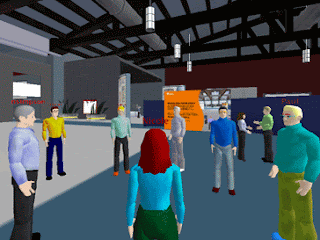
Virtual worlds like Second Life, There.com, and more business-focused offerings are on the brink of becoming valuable work tools. Major companies and public-sector organizations — such as BP, IBM, Intel, and the US Army — are investing heavily in virtual world technologies. But it's still early, pioneering days. You've practically got to be a gamer to use most of these tools — setup can be arduous, navigating in a 3-D environment takes practice, and processing and bandwidth requirements remain high. But within five years, the 3-D Internet will be as important for work as the Web is today. Information and knowledge management professionals should begin to investigate and experiment with virtual worlds. Use them to try to replicate the experience of working physically alongside others; allow people to work with and share digital 3-D models of physical or theoretical objects; and make remote training and counseling more realistic by incorporating nonverbal communication into same-time, different-place interactions.

Virtual worlds will soon be as important as Web to companies
Forrester says 3-D Internet will vastly improve collaboration and corporate training
January 9, 2008 from Computerworld
While virtual worlds like Second Life have come under fire for failing to provide enough value to businesses with established storefront operations, a new Forrester Research Inc. report argues that the 3-D Internet will be as important to companies in five years as the Web is today. The "Getting Work Done in Virtual Worlds" report released by the IT research firm this week concludes that executives should begin investigating and experimenting with virtual worlds soon because of their promise for remote collaboration, training and the ability to build and share 3-D models. The report said that today's collaboration tools offer far more limited benefits to companies. For example, the inability to see the gestures of fellow meeting goers causes problems for attendees in different offices, the report noted. In a virtual world, people can have their name, job title and business unit associated with an avatar that can attend meetings and have access to virtual buildings, rooms, equipment and people, Forrester said. The avatar is controlled by information in an enterprise directory and access control system, it said.

"You can easily direct your avatar to express gestures and emotions … plus you can leave behind real-world unpleasantness such as the poor heat in your cubicle while your next door neighbor is burning or the loud guy talking the phone next to you," according to the report. "[In meetings] you always know who is talking and who's anxious to jump into conversation because they are waving their hand or jumping up and down in the corner of the room. "In a virtual meeting room, you can see who is present, and more importantly, who is multi-tasking, who has raised a hand or who has been away from their keyboard so long that their avatar has fallen asleep," the report said.

Sun's Virtual World "Project Wonderland"


Excellent look at Sun's Virtual World by CIO Magazine;
Inside Sun's Virtual World for Internal Collaboration - C.G. Lynch, CIO January 11, 2008 "During the past couple of years, virtual worlds have received a lot of media attention, especially Second Life, the virtual environment created by Linden Lab that 1.3 million people actively use to play games, do business and live alter egos via their avatar stand-ins. But when Sun Microsystems thought about how it could use a virtual world to improve internal collaboration and facilitate social interactions among its 33,000 employees, spread out across offices around the world and in numerous home telecommuting sites, it began to think about building its own virtual world behind the firewall. Thus, Project Wonderland was born. Started about a year ago as a collaborative effort between Sun and the open-source community, Wonderland is a virtual, 3-D website that allows people to build virtual worlds based on Java programming. Sun’s internal world, MPK20, was built on this platform and started in June 2007. The name stems from the company’s Menlo Park, Calif., corporate campus, which has 19 buildings (MPK1 to MPK19), making MPK20 the virtual world extension. While the group building and developing MPK20 spends the most time in it, Sun hopes to start bringing in more user groups in the coming months. CIO.com’s C.G. Lynch visited Sun’s labs in Burlington, Mass., to see MPK20 for his own eyes and talked with Nicole Yankelovich, who works as the primary investigator at the company’s collaborative environments group.

CIO.com: What led Sun to start building a virtual world for its employees? Was there a tipping point that spurred it?

Nicole Yankelovich: About a year ago, we informally did a study by interviewing a bunch of our employees who work from home. Meanwhile, we tracked the statistics of how many people badge into our facilities each day. We found that many people worked from home full time, and some at least part time. This isn’t bad. [Without the commute] they often work longer hours and are very productive. Meanwhile, we also have a lot of people traveling to visit with our customers.

In the end, what we found was on any given day, more than half of our employees are working remotely. There are a lot of good benefits of a distributed workforce, but there are also some drawbacks. What they’re missing is the social interaction. We know, from business literature, that social interaction is very key to good business outcomes. You need to be able to trust people in order to get work done effectively or negotiate in business. Virtual worlds seemed like a great opportunity to address this problem.

What makes virtual worlds more compelling for that social interaction than existing technologies, such as phone and video conference?

Up until now, Sun, like most companies, has used audio conferencing. We’ve used a little bit of video conferencing too, but a lot people working at home don’t have video because that’s their personal space. So we mostly use audio conferences. The problem with this is we’re not getting the social interaction and the informal brainstorming you’d get in person. We figured [we] can create a virtual world where you can begin to re-create that social interaction, and then we could really create a wonderful place to bounce ideas off each other, both as a group or just between two people.

The consumer virtual worlds, like Second Life, have seen pretty significant user adoption. With that comes the need to scale. When you think about Sun's virtual world and getting thousands of employees on it, how will you plan for scale?

Second Life and other online games use this process called sharding. This means pieces of the virtual world are hosted on specific servers. So servers will have their capacity, and when it fills up, it fills up. For example, if a bunch of people decide to visit an island in Second Life, and that island begins to fill up with avatars, so does the server assigned to it. Meanwhile, you have all of these other unused servers. This is a huge problem in almost all the multiplayer games.

So at Sun we decided we’d use Darkstar, our game server. It’s a scalable platform that doesn’t do sharding. Instead, the [virtual world] developers write their applications as if they’re on one giant server. Then the underpinnings of the Darkstar servers allocate resources as they're needed. If one server starts to fill up and get near capacity, it goes to another one.

When will something like this become available for large enterprises?

Right now, Project Wonderland is open source and people are free to use it. But this whole project has been more popular with people initially than we thought it might be. So we have started to work with business development to see what Sun could do for customers. Maybe we could provide hosted services, or even manage the service (and server) for them behind the firewall. There are a lot of different models to explore. But for right now, we want to get more people using it here internally.
From www.cio.com

Thursday, January 10, 2008

USB Pay - Cool!


Shinhan Card rolled out Korea’s first ever USB type credit card on December 27. The USB credit card provides the online and contactless payment function and works the post-paid transportation card as well. The built-in IC chip includes the public authorization and the internet credit payment programs. During the online payment, users do not need to insert the credit card number. Rather, they can pay by connecting the USB to the slot. At the franchise stores with the IC card reader, it enables the no-touch payment. The card also supports the information inquiry and the automatic log-in service using the public authorization and the built-in internet payment programs. However, it is limited for users to delete or save data so that the USB itself cannot be used as a portable storage device. Shinhan Card plans to issue the existing plastic credit card, Shinhan Love Card, as well until the IC chip readers become popular among the franchise stores. The company said, “It provides the online and contactless payment functions. And the card itself can be an accessory as well. We think those young customers familiar with the online and mobile payment will prefer the USB type credit card.”

California Lawyers on Virtual World Law


California Lawyer Magazine has been putting together a piece on law in virtual worlds for a little while, including some research at Virtual Worlds Fall 2007. It's a good rundown on a lot of the legal and government activities in virtual worlds and offers a lot of background for lawyers not already involved in virtual worlds as well as an exhortation to get involved. Or, as Beth Simone Noveck, a professor at New York Law School, put it "People are appearing with new visual identities and likenesses, trademarked brands are appearing in virtual shop windows, and ownership of avatars [is] being settled in divorce and probate proceedings. The law is having to grapple with questions that are similar to, but not all the same as, what we've confronted in two-dimensional cyberspace." Read the full article here http://californialawyermagazine.com/story.cfm?eid=890855&evid=1]

Gaia Trawls Bebo

Gaia Online received a burst of funding from Time Warner after an investment from Sony just last month. Both Sony and Time Warner's Warner Bros. have also signed deals to distribute their film catalogs to Gaia's 3 million monthly users. Apparently a large part of those users are coming from social networking site Bebo, which claims 40 million users. Gaia launched its Gaia OMG app on Bebo last month. The social networking app, which allows basic functionality in the virtual world has gone from Gaia's 430th largest traffic referrer to in the virtual world's top 10.

Project Outback Kaput

Outback Online, the virtual world project from Yoick, is finished according to a post on Yoick CEO Rand Leeb-du Toit's blog where he mentioned "the demise of the virtual world I was working on." In February it was reported on the stealth mode virtual world based on peer-to-peer technology and aimed at teenagers. Then in May sources reported that Warb, who had been providing the front end, would be splitting off to go in its own direction, now focusing on user-created virtual worlds. At that time we were told by sources close to the company that it was having trouble raising funding. "Partly because of the dynamic nature of the space…there have been some fundamental shifts over the Summer of Facebook, hugely positive trends that have validated my decision not to continue with Project Outback," explained Leeb-du Toit.

Virtual World Payments "Paynova and Entropia Expand Cooperation"

Paynova, an Internet payment service, has been in Entropia since 2004, allowing users to use Paynova both in the virtual world and the real world. Now Paynova is expanding in Entropia to allow users more payment options, including debit card, Internet bank and a number of local payment methods in Sweden, the Netherlands and Germany. Entropia will also implement Paynova's one2one service, which allows users to use the same transaction service for subscriptions or microtransactions. "We have worked hard on preparing our new offer for online gaming. The payment service has only been in place a short time, and it is, therefore, particularly valuable to be able to implement it fully with a significant player within the segment. We view the expanded cooperation with MindArk as proof of the competitiveness of our new payment service and as an important basis for continued success in the growing online gaming segment," said Karl Alberts, Marketing Manager at Paynova.

Gartner's Take on Virtual Worlds and Payments


"All consumers pay between three to five percent more on goods purely to fund payment systems," said Gartner vice president Andy Kyte at the Gartner Symposium last week.
This is not only due to the money that credit and debit card systems cost retailers, it also comes from processing the cash in everyone's pockets. "Cash processing is unbelievably expensive," said Kyte. Singapore long ago decided it was too expensive to process cash, according to Kyte. In 1998, the Board of Commissioners of Currency in Singapore proposed to create an electronic currency — Singapore Electronic Legal Tender (Selt) — which Kyte said will go live at the end of next year. According to the Organisation for Economic Co-operation and Development's 2002 publication The Future of Money, Selt will be issued in Singaporean dollars. Banks could then draw Selt from the Board of Commissioners of Currency and load it onto their computers.

Any person requiring money could then draw electronic funds onto devices including mobile phones or smartcards. Last year, Singapore unveiled a standard — Contactless e-Purse Application (Cepas) — which allows merchants to only have one system to deal with multiple cards. The implications for the rest of the world are huge, said Kyte: "Lots of countries in the world are looking very, very closely at what is happening in Singapore." E-payments also cost both shoppers and retailers money, Kyte said, but the amounts are typically lower than existing payment systems. The e-payment push is not only coming from the price of payment processing: virtual worlds are contributing to the drive to use electronic currencies, such as Second Life's Linden Dollar, with some unwanted consequences. Virtual worlds with e-currencies create phenomenal opportunities for money laundering and tax evasion, said Kyte. "Most of the issues [of electronic money] are around the idea of security," said Kyte. Once this is worked out, it will only be a matter of convincing consumers of the technology. Consumers are wary of currencies like Linden Dollars because they are unsure of their permanence, Kyte said. He likened the current e-money situation to a "primal soup" — a lot of ideas floating around that will eventually consolidate into the type of services consumers want to use. Banks, he said, are likely to be the losers unless they jump on the trend. "Smart banks will buy into it and overwhelm," he said, advising banks to "go and get a few teenagers" and run a research project.

Smart2Pay


Smart2PayTM is a Payment Service Provider specializing in internet payments since 2002. They have an HQ in Amsterdam and strategic alliances with partners in the US, France, Belgium, The Netherlands, Romania and Germany. Good source of state of the art payment solutions for internet merchants.

Telekurs


Good swiss know-how for payment processing.

Ogone's Payment Network


This Belgian company has an excellent system and network.

Just Jealous?


Valleywag Duudes are at it again with their constant unfair SL-bashing. While admittedly hilarious, Paymentguy cannot wonder if these Bloggers at "Silicon Valley's Gossip Tech Rag" are just plain jealous. Even San Francisco's mayor Gavin Newsom raves about SL and how it mirrors his home city; "Gavin Newsom, San Francisco's freshly reelected god-mayor, descended into the bowels of Second Life for a quaint fireside chat with Philip Rosedale, CEO of Linden Lab. What lofty matters could a city mayor and the chieftain of a seamy virtual world possibly have to discuss? Why, the parallels between the "two famously diverse and tech-savvy communities with global profiles," of course. As Newsom said during their discourse, "We're all geeks." But the comparisons don't stop there. San Francisco is exactly like Second Life.

A surfeit of self-expression: San Francisco may not have furries actively roaming its streets, but you'd be hard pressed to find another community so accepting of trannies, facial piercings, fauxhawks, and assless chaps. Oh wait -- this June, San Francisco will have furries actively roaming its streets. See? Just like Second Life.

Toleration for public sex: Second Life has always been plagued by a seedy, fornicating underbelly. San Franciscans simply need visit SoMa.

City of lost souls: Anyone who visits San Francisco's Civic Center has witnessed the crazies, drug addicts, alcoholics and other afflicted. On Second Life, they just don't stink.

Statistical self-delusion: San Franciscans believe they're the center of the universe, though the city they live in isn't even the largest in the Bay Area. The same can be said of Second Lifers, who can't believe that the other 99.7 percent of the world doesn't want to join their party.

A plague of wantrepreneurs: When Anshe Chung became the first Second Life millionaire, she started a gold rush, though one mostly without the gold. People have flocked to the virtual world in the hopes of striking it rich, just as countless misguided startuppers race to South Park in hopes of running into a venture capitalist.

A ghost town much of the time: With a population of 744,000, it's hard to argue that San Francisco is a big empty, but if you've tried to find a restaurant open after 10 p.m., you might start to believe it. Much like Second Life, whose residents are all too fleeting in their visits.

A sense of impending doom: There's no escaping it. Some day all those Second Lifers will wake up from their bad dream and realize the whole experience is just some terrible pyramid scheme. It will crumble into ruin -- just like San Francisco after the Big One strikes. http://valleywag.com/342845/san-francisco-is-just-like-second-life

Wednesday, January 9, 2008

Pretty Crap?

SL Brand presence "pretty crap"? The brand guys at the Blake Project Blog think so; "It all sounds pretty amazing, until you visit Second Life. Having spent last weekend walking around its virtual universe, I have to report that the whole thing is pretty crap - a bit like Milton Keynes with a very bad hangover. The branded locations that sounded so impressive in the pages of BusinessWeek are very basic and virtually devoid of visitors. Despite Second Life's bold claims of 8m residents, the limited server space means that locations can handle only 70 avatars at a time. Once you leave the congested entry portal, however, this is hardly a problem as most of the site is eerily quiet and deserted. I grew so bored and lonely in Second Life that I resorted to removing my trousers and shouting at the occasional avatars that passed by in a desperate attempt to make contact." www.brandingstrategyinsider.com/2008/01/second-guessing.html

Second Life Cable Network to Broadcast A Panel on Financial Policy Changes in Second Life

SLCN.TV will provide a live broadcast of a panel discussion on the recent changes to the financial services policy in Second Life on January 10, 2007 from 11am to 12 pm SLT. The panel discussion is a special Metanomics presentation to be hosted by Professor Robert Bloomfield, of Cornell University's Johnson Graduate School of Management. According to Bloomfield, "Many people anticipated that Linden Lab would eventually crack down on unregulated financial services in Second Life. However, the financial community was clearly taken by surprise today, when Linden announced that they were banning all banking activity, absent evidence that the financial institution was submitting to real-world regulation from an appropriate body."
"The announcement seems sure to eliminate virtually every bank currently operating in Second Life. Already, banks are experiencing runs, stock prices are falling and some land has been seen listed at fire-sale prices. However, several questions remain. It isn't clear whether this banking crisis will affect the Second Life economy, or the experiences of users who have found the financial sector of Second Life to be a source of interest and entertainment (if not profit). It also isn't clear how the policy affects the dozens of firms that issue equity securities on exchanges (all of which are tied to banks)", says Bloomfield. Bloomfield says that those tuning into this Metanomics session will get a better insight into the history behind this change in policy, and its likely short- and long-term implications. Current guests on the panel are:
• Travis Ristow, BCX
• Intlibber Brautigan, Ancapistan Capital Exchange
• Ben Duranske, Virtually Blind
Catch the live coverage exclusively on SLCN.TV

Chicago Tribune on Kiddie Virtual Worlds


"Toys increasingly tied to online worlds created for children to explore"; " A growing number of online tie-ins to toys such as Barbie, collectible trading card games and even stuffed animals are joining established kids-geared online communities to create what will soon become hundreds of social networks and virtual worlds for children. No one expects Web-enabled toys such as Webkinz stuffed animals or the online world devoted to Bratz dolls (Be-bratz.com) to completely supplant Lincoln Logs and Play-Doh. But in a relentlessly wired world, toymakers and those who specialize in kids' entertainment are finding children are already online and looking for virtual playscapes to explore. In a recent study, a senior analyst at consulting company eMarketer Inc. estimated that about 20 million U.S. children and teen Internet users will visit online virtual worlds at least once a month by 2011. Some of the most popular toy and game sites geared toward kids -- including Neopets.com, where kids can care for virtual pets, or the Antarctic-themed, Disney-owned ClubPenguin.com -- already have millions of players, and many more online communities such as these are on the way. Many toys manufactured by companies such as Mattel Inc. now routinely include an online component allowing kids to take their play online. Webkins and Barbie Girls toys, for instance, are playthings that include a large online component: Kids can buy virtual goods for their Webkinz or play dress-up with their Barbie Girls on a Web site.

4Kids Entertainment, the company behind the popular Pokemon and Yu-Gi-Oh franchises, is launching a collectible trading card game that will include a way for players to battle one another online. The game is based on a popular Saturday morning cartoon, "Chaotic," which runs on Fox affiliates. Eventually, kids will be able to chat with one another while playing with their trading cards online -- each purchased card has a unique code that can be entered on a Web site, chaoticgame.com, for free online play. Carlin West, executive vice president of acquisitions and development at 4Kids, said "Chaotic" has been in the works for three years and is the foundation for other online games and virtual worlds that will target young players. "Kids are spending more time online," West said. "Therefore entertainment truly has to migrate online if it's going to have any presence with children. If online play is essential, then toymakers have to adapt to that position." The trading card game and its online equivalent keep kids invested enough to tune in to the TV show, she said.
www.chicagotribune.com/features/chi-0101digital_toys_subjan01,1,4938536.story

Pokemon Guys to Start Virtual World


4Kids Entertainment, the company behind the popular Pokemon and Yu-Gi-Oh franchises, is launching a collectible trading card game that will include a way for players to battle one another online.

CIO Mag on Webkinz "Webkink Just Too Successful"


Good "Techmical Look" at Webkinz from CIO Mag and Bernard Golden; Every "Web 2.0" site dreads being too successful, and for Webkinz, that unhappy situation arrived December 26. Webkinz, if you're not familiar with them, are furry stuffed animals that have a Web 2.0 social media site that accompanies them. My kids are crazy for Webkinz, rifling all the local stores (and the San Jose Tech Museum) for them. Every Webkinz comes with a numbered tag. You enter the tag number at the Webkinz site and "adopt" your pet. By playing games, you earn KinzCash, with which you can buy stuff for your pet. There is a social media element to the site, in that you can interact with other people signed in by choosing from a number of available statements (e.g., "How are you today" and the like); limiting the interaction to Webkinz-provided statements precludes unacceptable language and the like. You can learn more about Webkinz at wikipedia. Wikepedia's entry on the little furry beasties seems to imply that Webkinz has passed its popularity peak, but, based on December 26, I'm not so sure. That's when my sons, eager to register their new pets, found the Webkinz site down. I think the site pooped out under the load of a zillion kids all wanting to get up and running with their new pet. I asked one of my sons to walk me through Webkinz world. It seems like you complete various tasks to earn money to decorate your pet's house and keep it fed, happy, and healthy. Frankly, it all seemed a bit too much like work for me to generate much enthusiasm for it. However, for kids of a certain age, Webkinz is catnip.

During the tour, one of the pages faulted and displayed an SQL error. I didn't get a chance to look at it in detail, but from a cursory look it sure seemed like a MySQL error. It certainly makes sense Webkinz world is open source-based. Open source powers most of the highly-scaled Web 2.0 offerings, since their businesses need significant scalability without increased software license fees every time they need to add new servers to keep up with the usage. Overall, I'd say Webkinz is a particularly brilliant offering. By tying participation to a physical good, the company can fund the technology without having to rely on ads, which many parents (myself included) find unacceptable. Certainly the company extracts a premium price for the animals, giving it better margins in a (forgive me) dog-eat-dog toy market. And using open source (assuming they do, which is a pretty safe bet) means their social site, which offers a more engaging experience than a mere stuffed animal, is affordable to build at scale.
http://advice.cio.com/bernard_golden/webkinz_scales_a_wall_of_little_users

Banks Banned in Second Life


Linden Lab has announced that virtual banking within Second Life is to be banned effective January 22 after receiving multiple complaints by Second Life residents scammed by bank operators. Banking and associated services have become popular in Second Life over the last two years, with many offering ponzi style interest schemes that usually sounded too good to be true. Ginko Financial was the best known failure amongst Second Life banks, owing 200 million Linden ($750,000) to depositors when it declared itself insolvent in August 2007. In a post on the Second Life blog, Ken Linden said that as well as not being able to provide protection to Second Life users with these banks running, their legality under law is also questionable. The decision is unlikely to affect virtual stock exchanges but may affect groups such as Second Life credit card provider Metacard, who also previously offered bank services as well. Second Life banks are experiencing a run on their funds as customers seek to get their money before the ban comes in place. Companies such as JT Financial have been inundated by customers wanting to know what is going on. Screen shot of the JT Financial crisis meeting below. Banking joins bestiality and gambling on the banned in Second Life list.

Related issues arose in a 1-1 between a Linden Exec and a Cornell Economics Professor where Linden repeatedly characterized SL as a software "service" or "product" and distanced SL from economic nomenclature; "Yoon dodged Bloomfield's questions about Linden Lab managing a monetary policy in-world by repeating his mantra about the metaphor being a distraction from Linden's business of offering a service to customers. Yoon likened Linden's business offering Second Life as “software as service” and drew parallels to both an Internet Service Provider offering e-mail services and a company like eBay offering a platform where customers can transact business amongst themselves. I found it fascinating that Ginsu dispenses with the usual metaphors like thinking of in-world activity as an 'economy,' Lindens as 'money,' or sims as 'land'....or anything that would interfere with his preferred metaphor of 'SL as product,' said Bloomfield after the panel. “This very pragmatic perspective does a nice job of making what seems novel and complex - World of Warcraft with real money? - seem familiar and straightforward (such as) E-bay and e-mail with great visuals.”

Bloomfield wondered what Yoon might be “throwing away” by eliminating the metaphors. He pointed to the fact that Second Life does have an economy and believes that Yoon should be thinking about “the supply and demand of product features that are traded freely among customers.” Regardless of Yoon's perspective, the “product” is still novel and complicated, Bloomfield said. At the start of the panel, Yoon admitted that he tends to see things in “black or white” terms and that his views do not always reflect the universally accepted views within Linden Lab. Said Yoon, "Give people what they want from a product perspective – Linden Lab has a responsibility and opportunity to satisfy user demand, to give them the product functionality they want.”" www.slnn.com/article/metanomics-ginsu-linden/

Tuesday, January 8, 2008

Here Come the Pandas! (In German)!


www.panfu.de And here they are on YOUTUBE www.youtube.com/watch?v=WlcCOuqjdpM
Their payment partner is a new Dutch processor www.adyen.com that has ex-BiBit people.

Monday, January 7, 2008

Mobile Virtual Worlds


Great blog post by HABBO Genius and Sulake Owner Sampo Karjalainen (aka Chief Creative Officer) at the Sulake Blog. Sampo, along with his HABBO partner Aappo Kyrola, is one of the true virtual world visionaries PaymentGuy ranks right up there with Philip Rosedale, Raph Koster, Howard Ganz and the Club Penguin Trio. From the post; "Tens of millions of people use virtual worlds on PCs. World of Warcraft, Habbo, Second Life, Club Penguin and other virtual worlds have made them mainstream online entertainment. And it doesn't stop there. Some analysts and experts believe virtual worlds to be the next major phase in the development of the Web. Gartner predicted in April: “By the end of 2011, 80 percent of active Internet users (and Fortune 500 enterprises) will have a ‘second life’, but not necessarily in Second Life.” On the other hand, another future prediction is the rise of mobile Internet. Internet use is currently being detached from the PC environment and expanded to various mobile devices. In the crossroads of these trends is a vast uncharted territory: virtual worlds on mobile devices. And I have a tickling feeling that we'll see something interesting development in this field soon :) We at Sulake started thinking, designing and prototyping mobile Habbo Hotel already some years ago. In 2004 we developed two mobile Habbo prototypes, but the time wasn't right for a commercial product. It worked only on high-end phones that teens didn't have and data traffic costs for users were just too high...

Sunday, January 6, 2008

WebKinz Mom Trashes Webkinz For Stuffed Ponies Wearinig Rhinestone Studded Jeans ...


From the Webkinz mom blog on the commercialization of kiddie worlds: "Of course, Web services are businesses, and many of them are very big businesses. I do not object to paid services, but I am very concerned about the rampant commercialism that is built into many entry-level Web activities for kids. My 8-year-old doesn't yet know that she is "supposed" to covet a flat-screen TV, but on Club Penguin, kids are taught that it's really cool to buy one for their avatar penguin's igloo. Webkinz has a virtual world/real world upsell strategy. You buy a stuffed animal that has an online counterpart who socializes in the online world. Then you are encouraged to buy KinzStyle outfits for your stuffed animal, and those outfits show up on your avatar as well. To get into the online KinzStyle shop, where you can buy virtual clothes with KinzCash, you have to have bought a real-world outfit for cold, hard cash. So the $15 stuffed animal turns into a major investment, and your little kid who wasn't worried about fashion turns into Paris Hilton. OK, that's over the top, but the concept of a stuffed pony wearing rhinestone-studded jeans, in real life or online, just about blows my mind."

UKash Partners With Vodafone


Really cool and useful service offered from UKash via Vodafone - mobile prepaid codes for cash... "Digital cash outfit Ukash is partnering with Vodafone to offer its debit and credit card alternative via mobile phones. Ukash is aimed at people who don't have credit or debit cards or do not want to use them online. Users purchase vouchers at retailers and then enter the unique and secure number at Web sites that accept Ukash. Through the Vodafone partnership customers can now purchase vouchers by visiting the Ukash Mobile Web page using their phone's Internet browser. The user is charged £11 for a £10 voucher, which is paid for by 'pre-pay' mobile phone credit. The customer then receives a SMS text message containing a 19 digit Ukash number which can be used to make payments on Web site and mobile Internet sites that accept the system. The service is powered by the AirPayment mobile platform from wireless Internet service provider Hybyte. Mark Chirnside, CEO, Ukash, says: "This new service makes getting Ukash even more convenient for mobile users, meaning they can get a voucher straight to their phone 24/7." www.finextra.com/fullstory.asp?id=17826

Digital River Buys Netgiro


Netgiro is great so smart aquisition by Digital River. Good luck guys
http://corporate.digitalriver.com/store/driv/PressReleases/sectionName.company/subSectionName.newsEvents/pr.81408500

Avatar Rip-Off


David Talbot of MIT Technology Review (no that's not him in the pic ... but a RL person named Stephanie Roberts who got ripped off in SL) in "The Fleecing of the Avatars" discusses the mercenary world of ecommerce in SL and profiles the Ginko scandal: Ginko--operated by an avatar called Nicholas Portocarrero, whose real identity is not clear--persuaded hundreds of people to deposit their Linden dollars. The reasons for what happened next are murky, but the results were clear enough: the "bank" vanished, and depositors say their money did, too. In July 2007, residents began clustering around machines to try to recover their money after Ginko began restricting withdrawal amounts. Then Ginko announced that deposits were now in "Ginko perpetual bonds" rather than Linden dollars. Those bonds soon plunged in value, and in October, they ceased to exist. The reported losses may have totaled $700,000, according to Ben Duranske, a lawyer based in Idaho who writes a blog on virtual legal issues. Some Second Lifers have reported losing thousands of dollars in Ginko. Roberts is among the luckier ones: she says she lost only her $144 in savings. But the point isn't just that somebody other than Roberts ended up with her money. What may be most significant is that nothing happened to whoever may have taken it. Her money disappeared into the 3-D ether" http://www.technologyreview.com/Infotech/19844/?a=f

Thursday, January 3, 2008

Funny Take on Kiddie Virtual World's From a "Geek Who Has Procreated"

It encourages a vapid collector mentality not only online but in real life as well. The more crappy little dolls you buy at the mall, the more crappy little virtual characters you can have. Crappy little virtual characters that exist to work virtual jobs so they can make virtual cash to spend on more useless virtual crap. Now the makers of Webkinz claim this teaches kids responsibility because their online counterparts have to earn money before they can spend it. On crap. Of course these claims are pulled from the ether as there has been no research done on these new games. Such defenses remind me of my own bullshit justifications for playing so much Galaga back in the day, "But mom, it teaches hand/eye coordination!" It seems to me the site teaches kids that money is made to be spent on superficial garbage. Sure, kids hardly need to be taught to want every shiny trinket they see on the shelves. But by making kids "work" to earn their virtual trinkets, Webkinz is legitimizing the pursuit of materialism by equating it with responsible adult behavior.
Club Penguin is guilty of this as well. You may not have to buy any stuffed penguins at the toy store, but you can buy fashion accessories for your penguin characters. And I have to shell out six bucks a month. That's real bucks, not virtual bucks.
http://www.nerdswithkids.com/2007/09/building-new-generation-of-online.html

Pappa Nerd - Doug Slack's "credentials" - hilarious! "NERD CREDENTIALS- Still own the Shogun Warriors Godzilla toy, complete with launchable hand, from 1979. Saw the Star Wars Christmas Special during it's one and only television broadcast. Have over 30 long boxes of comic books stored in the attic. Saw Evil Dead 2 in the theater three times. Once dined with Tom Savini. Wrote and illustrated my own comic book in the 90's. Spent countless lonely hours watching Night Flight and The Young Ones as a teenager. PARENTAL CREDENTIALS- Father of two daughters, ages 2 and 8."

MyMiniCity


MyMiniCity is a new Flash game that allows you to create your own online city. All you have to do is have people visit the site and your city evolves with every click. (Not to mention upping the site's page views for advertising purposes!)

Here Come The Bears!


In Winter 2007, Build-A-Bear opened their online virtual town. Dubbed "Build-A-Bearville," this online city allows users to play games and chat in a relatively safe community. Those users who own Build-A-Bears bought after October 2007 can bring their furry friend to life online by entering their bear's special code. This code is found on the bear's birth certificate. If a user has a furry friend from before October 2007, they can (for a limited time only) pick up a "Welcome Pass" at any Build-A-Bear location. Then, they use the code on this "Welcome Pass" to bring up to 5 of their furry friends to life. Users without a furry friend have only limited access of the town. Build-A-Bearville includes a Pawforming Arts Center (where bear-owning users can dance with their bears and play a DJ game featuring Build-a-Bear songs), a virtual Build-A-Bear Workshop (where users can play games, bear-owning users can dress up their bear, and users can use codes to bring their physical Build-A-Bear friends to life), a Libeary (where users can play a traditional matching tiles game, listen in on "Story Time" to a Dr. Seuss story, download desktops and other fun stuff, and begin quests for magic jewels and the like), a neighbearhood (where users can play a twist on "Hide-and-Seek," and bear-owning users can visit their own Cub Condo or a friend's), a forest (where users can play several games - hand-eye coordination games such as "Photo Safari" and "Dunking for Apples," word games such as "Words fur the Birds," and games such as the "Pie Eating Contest." Also included is a cute "Canine Care" game.), and more. Build-A-Bearville citizens, upon logging in, can select their country and then a "Den." (a Build-a-Bear online synonym for "server") '- from Wikipedia

Tuesday, January 1, 2008

Payment Myths

APACS, the UK payments association, has published a new report – Payment Myths – that uncovers the facts behind payment trends in Britain. The booklet uses statistical evidence to help consumers better understand the payment options available to them and offers advice on the best ways to manage their finances; no matter what payment method they use. The Payment Myths report uses APACS statistics to show examples of the way we use cash, our susceptibility to fraud and the new demographic make up of online bankers – to name but a few. Sandra Quinn, director of communications at APACS, said: “The Payment Myths report offers some interesting insights into payment behaviour amongst British consumers and looks to shed light on some common misconceptions.”

“Despite growing acceptance and familiarity with the variety of payment methods available to consumers today, common stereotypes remain. While new technology means we can now bank online 24 hours a day or have our groceries delivered with the click of a mouse, traditional methods like cash and cheques continue to endure.”

Myth: People only use cash for small value items
Fact: Of all payments over £50, we are more likely to use cash than credit cards
Myth: People don’t pay the monthly balance on their credit card
Fact: 68% of people usually or always repay their credit card balance in full
Myth: Over 65s don’t use online banking
Fact: The over-65 age group is one of the fastest growing groups in terms of online banking users
Myth: No one uses cheques anymore
Fact: There is almost the same number of payments made by cheques as by credit card

Will All These Penguins & WebKinz & Habbos Join Second Life When they Grow Up?


Stan Trevena thinks NOT!
________________________________

From: educators-bounces@lists.secondlife.com on behalf of Trevena, Stan
Sent: Mon 12/31/2007 1:22 PM
To: SL Educators
Subject: RE: [SLED] kiddie virtual worlds exploding...nyt

I've got triplet 15 year old boys and a 9 year old boy. My trips were into Neopets in the early years, and they have played most of the MMO's since. My 9 year old is into Club Penguin. What sets all of these other "virtual worlds" (more on that in a minute) apart from SL? Mini-games. Or put another way, "Short Attention Span Theater". These worlds are built on earning points and spending them on trinkets, be those neopets or accessories for your penguin and igloo. You earn your points by playing web flash games, many that are based on old arcade hits and new variations on that theme. Most of these mini-games only run a few minutes long. Another recent entry is UB Funkeys. This one is clever, in that it looks and feels like a virtual world, but you never really bump into other players, you only visit their houses when nobody is home to see all their "stuff". UB, Barbie and Bratz all use USB dongles and mini-toys that dock with a reader to unlock areas of their "virtual worlds".

I've not read the NYT's article yet, I just got in, but there are HUGE differences between these kiddie "virtual worlds" and SL. Interaction in these other worlds ranges from limited chat and no avatar mixed spaces to 2D screens where small avatars crowd the screen with chat bubbles floating above their heads. None of these platforms are "virtual worlds" where there's anything close to the open ended environment of SL. I would classify these worlds more as a wrapper placed around a large collection of flash games (the different lands are really only groups of games) that drive the kids to earn points to buy cool virtual objects, reset then repeat indefinitely. What is even more pathetic is that they don't even play the games that they really enjoy, they play the games that give them the most points the quickest. No surprise that the games that pay the most points are linked to new movies or toys that are coming out soon. It's the old "rat - button - food" reward activity. If the games had some educational value, or some purpose other than building their hand eye coordination they may be more redeeming in value. As they stand, they are simply virtual attention drains for teens who want to push buttons to get virtual rewards while sometimes having ads or themes flashed at them (movies, TV shows, etc). None of my kids have any relationships or communications with others in these worlds. I would classify them as the junk food of "virtual worlds", good for a light snack, but mind numbing in any quantity.

Will these kids flood into virtual worlds like Second Life when they tire of these worlds? Not likely. This model increases and deepens the boredom factor of these kids if they are not fed activities minute to minute to occupy their short attention spans. I believe these games have replaced cartoons over the past several years for most kids. Give them an open virtual world like Second Life and they quickly get bored and leave. They might stick around long enough to explore anything with bright lights or flashy graphics, then they will leave never to return. Maybe this behavior is already invading SL and contributes to the 10% retention numbers we already see? Maybe our schools are causing this behavior, we have drained most of the creative thinking and social activities out of our schools and instead now focus everything on test scores, test taking and cramming for tests.

Kids from these "virtual worlds" will be much more likely to invade worlds like WOW and Tabula Rasa than Second Life (assuming they are looking for social interactions and shared quests). But their more logical place to go after they grow out of the kiddie virtual worlds are places like Maple Story (http://www.maplestory.com/) and DOMO (http://domo.aeriagames.com/). These clearly draw their lineage from the Neopets and Club Penguins of the world, and slap a 3D virtual environment on top. Maple Story was purchased by Wizards of the Coast, the makers of the still popular Magic the Gathering Collectible Card Game. Is it by chance that Maple Story has a collectible card game (available at Target, among other places) that have secret codes for virtual items printed on one card per pack? (http://ww2.wizards.com/maplestory/). Last year even Blizzard succumbed and released a collectible card game of their own (http://entertainment.upperdeck.com/wow/en/) centered on the World of Warcraft universe. And yes, there is that treasured secret code in random packs that will land you really cool and high bid fetching eBay virtual item if you are lucky.

These kiddie virtual worlds are not much more than interactive virtual commercials wrapped around real world products. Instead of calling them "virtual worlds" they should be classified as "virtual commercials". MTV now own Neopets. Disney owns Club Penguin. Kids are running treadmills to get prizes. Hey, maybe they're 3D virtual happy meals, not virtual worlds. Better yet, if we can somehow generate power from all these mindless key pushing activities we could solve the global energy crisis (welcome to the Matrix). Oh wait, then they would be human batteries.

I guess I'll go and read this article now that I've expressed my personal views of these "virtual commercials". Comments on the article to follow soon.

Stan Trevena
Director, Information and Technology Services
Modesto City Schools
http://pacificrimx.wordpress.com

Professor Ondrejka


Cory Linden is going to teach at USC. He will be a smash hit with students I am sure. Here is his new blog: http://ondrejka.blogspot.com/

Monday, December 31, 2007

Designer Toys and Virtual Worlds ... At last!


Mattel stole my idea!!! Bastards ... just kidding. I actually predicted this back in 05 ...
What are the U.B. Funkeys™ and How Do They Work…
Radica’s U.B. Funkeys™ is the first interactive toy that integrates collecting with connecting. This innovative new product marries vinyl toy collecting with interactive computer gaming, delivering an all-new virtual environment filled with fun and games.
To play U.B. Funkeys™ users first purchase a starter kit. The starter kit comes with a U.B. Funkeys™ “hub,” two Funkeys character figures and PC software. Each collectible Funkeys character plugs directly into the U.B. Funkeys™ “hub,” which is attached through a USB cable to the player’s computer. When a Funkeys character is placed into the hub, the player’s onscreen avatar changes its appearance to match that of the specific Funkey connected to the “hub.” In addition, each Funkeys character unlocks new games and zones in the U.B. Funkeys™ world. The more Funkeys kids collect, the more zones they can unlock and games they can play.
There are 42 different Funkeys in all, some more common than others. Each Funkeys figure allows kids to play a specific game within the world and buy special items associated with that figure. By playing games in the U.B. Funkeys™ world, players earn coins that they can use to purchase items for their “crib.” Players can then customize their crib – from picking out furniture and painting walls, to adding carpet, plants and other home decor – then save and upload it to share with friends.
www.arkadium.com/case-studies-funkey.html

Here Come The Monsters!


They look kinda scary ... http://www.moshimonsters.com/

Virtual World's To Be Mass Market Entertainment


Good article in NYT on the proliferation of online worlds for kids and most intriguing insight on Disney's Virtual World Plan:

“Get ready for total inundation,” said Debra Aho Williamson, an analyst at the research firm eMarketer, who estimates that 20 million children will be members of a virtual world by 2011, up from 8.2 million today. Worlds like Webkinz, where children care for stuffed animals that come to life, have become some of the Web’s fastest-growing businesses. More than six million unique visitors logged on to Webkinz in November, up 342 percent from November 2006, according to ComScore Media Metrix, a research firm. Club Penguin, where members pay $5.95 a month to dress and groom penguin characters and play games with them, attracts seven times more traffic than Second Life. In one sign of the times, Electric Sheep, a software developer that helps companies market their brands in virtual worlds like Second Life and There.com, last week laid off 22 people, about a third of its staff. By contrast, Disney last month introduced a “Pirates of the Caribbean” world aimed at children 10 and older, and it has worlds on the way for “Cars” and Tinker Bell, among others. Nickelodeon, already home to Neopets, is spending $100 million to develop a string of worlds. Coming soon from Warner Brothers Entertainment, part of Time Warner: a cluster of worlds based on its Looney Tunes, Hanna-Barbera and D. C. comics properties....

Disney’s goal is to develop a network of worlds that appeal to various age groups, much like the company’s model. Preschool children might start with Pixie Hollow or Toon Town, another of Disney’s worlds, grow into Club Penguin and the one for “Cars” and graduate to “Pirates of the Caribbean” and beyond, perhaps to fantasy football at ESPN.com. “All the stars are aligning for virtual worlds to become a mass-market form of entertainment, especially for kids and families,” Mr. Yanover said.

PaymentGuy thinks he is right ...

The Question of How to Pay


... makes #5 on Gamasutra's Best Of 2007: Top 5 Most Significant Moments In MMOs. If you want this question answered in the New Year - contact PAYMENTGUY! Happy New Year

www.gamasutra.com/php-bin/news_index.php?story=16758. "At Austin GDC there was a panel on the last day of the event ostensibly intended to discuss the 'biggest opportunities' in online games. The reality of it was that the table was stacked with Marc Jacobs (a staunch opponent of Real Money Transfer) and two big proponents of microtransactions: Raph Koster and Eric Bethke. What resulted is described on Gamasutra as "a tussle for the future of online games". That one moment nicely summed up possibly the most important trend of this year, and speaks volumes about what we're going to be talking about in 2008.

The fight that day was about the value of paying a flat subscription fee versus microtransactions, as seen in games published by Nexon. Blizzard's well known acceptance of both models is an exception, as most companies choose one or the other as their business model. Ultimately, this may be a question that's out of the hands of the designers: American players are already indicating their love of micropayments and RMT by heavily playing newly arrived games of this type. Despite lawsuits and crackdowns, people are still paying real money for gold and other online currencies.

While I think it's unlikely we'll see many companies openly accepting gold sellers in their games, there are a few who have already begun to walk that path. The nebulous acceptance of the newly announced Live Gamer service by Sony Online Entertainment and Funcom speaks to the kinds of arrangements we might see in the future.

Lessons to learn: The only thing better than free is micro-payments. Players secretly like paying for gold. Celebrity game designer deathmatch would make an awesome show."

Saturday, December 29, 2007

Here Come the Camels!


Very cool kids camel world from Budapest based Napfolt. Love it! www.coolcamels.com

Here Come the Cats!


Do work around the house, earn points and dress your virtual cat ... what will they think of next? www.handipoints.com/howitworks.php

Second Life Japan - Dead?


I completely disagree that SL Japan is dead. After all, it has only been 5 months since SL Japan was released. Here is the critical expose by blogger shi3z as translated by Chris Salzberg;

Second Life in Japan is virtually dead. While three-dimensional environments such as “meet me” [ja] and Hatena World have seen their popularity rise, the most famous virtual environment in the world has seen its virtual space steadily depopulate in Japan. When a reporter from J-Cast went to check out [ja] some of the Second Life “virtual shops” and “virtual companies” earlier this month, the buildings were apparently still there but the inhabitants were nowhere to be found.

In his December 24th post entitled “A few things one should learn from the failure of Second Life,” blogger shi3z reviews the reasons why Second Life failed to catch on in Japan:

半年くらい前、国内でのセカンドライフは完全にバブル状態だったのですが、誰もがこれがバブルだと認識しつつ敢えて踊らされる側に回った、というのがとても印象的でした。知人のセカンドライフビジネス関係者で本気でセカンドライフをやっていこうとしているのは1割もいませんでしたし、みんな心のどこかで「まあこんなの今だけだし」と思っていた点は否めません。

About a half a year ago, Second Life in Japan was in a complete bubble state, but what was really striking was that everyone chose to be swayed by the trend even while they recognized that it was a bubble. Of the acquaintances I have who were involved in Second Life, not even 10 percent were serious about it, and it can't be denied that everyone, in their heart, was thinking: “This is not going to last.” http://www.globalvoicesonline.org/2007/12/27/japan-learning-from-the-failure-of-second-life/

see: http://www.mutantfrog.com/2007/12/17/second-life-in-japan-depopulating-j-cast/

Saturday, December 22, 2007

TAATU CEO Philippe Moitroux on Going English


See: http://www.virtualworldsnews.com/2007/12/interview-taatu.html for an interview with Taatu's CEO on cultural vs geographical expansion i.e.; working with cultural instead of geographical boundaries. "We recognize that language is the last social barrier especially between 10- and 19-year-olds, so we are very keen on offering other ways to communicate... From day one, TAATU has been a multi-lingual environment. We deploy our communities not based on geography, but on language. We have a French and Belgian community and now an English community. We expect soon to open Spanish and German communities. Now our demographic is mainly based in France, Belgium, and the Netherlands."

Moitroux describes TAATU as a fit between Habbo Hotel and Second Life. 70% of its users are between 10 and 19 years old with another 20% falling between 20 and 35, according to Moitroux. Almost no one is over 35. With approximately half a million registered users and a 24/7 monitored community, TAATU works with advertising integration to bring content to young users.

"Of course we're targeting the customers who have an interest in the audience we have," said Moitroux. "So the typical advertisers are coming in from the gaming enviornment or cosmetics or drinks and food, but also mobile telephones and banks—all those people who want to address a market of 10-19 reaching them in a very new way."
So far, he says, there's been a fair amount of interest from the UK and US. TAATU is a Flash-based environment that doesn't require a download. While that's traditionalyl been a positive factor for youth-oriented worlds, the US has seen a boom in client-download youth worlds like vSide. Likewise, last week saw the transition of Coca Cola from working in an online-only environment originally built by Habbo Hotel to working in the client-based program There.com. But Moitroux isn't worried about the transition. "We've been talking to advertisers who appreciate our look and feel and the content that we can give them as far as security is concerned," he said. "Instead of waiting to push by any means this 3D environment, our advertisers are more sensible to the amount of people who can view or play with the product. Our lighter graphics enable us to accommodate more people into our rooms. That's definitely one thing our members appreciate. I believe there will be a market for those worlds. But it depends what you're looking for. We definitely want to continue to be a product for the masses."

Taatu English in Private Beta


Taatu has huge potential. Already popular in France, Belgium and the Netherlands, TAATU, a Habbo Hotel-looking virtual world for young people, recently debuted an English beta version. The company describes it as a Flash-based "safe, managed and moderated environment where youngsters can enjoy rich multimedia content (e.g. music, events, game play)." English-speaking users can move back and forth between the other worlds as well, which have over half a million registered users on average visiting the site twice daily for 2 and a half hours spread out over the week. The demographic is 10 to 19 and split about evenly between male and female. A representative for the company pointed out that previously "the game was available, but without content." TAATU follows a similar pattern to Habbo and other kids worlds by bringing in artists for in world events, but in a different move, the chat sessions are hosted over webcam instead of just in the world itself. www.virtualworldsnews.com/2007/11/taatu-debuts-en.html

Here Come the Ponies!


He has already introduced America to a boy-oriented trading card game (Magic: The Gathering) and one with unisex appeal (Pokémon). Now, Peter D. Adkison is hoping to find new success with a line of collectible cards aimed at girls. This time the product may be a tougher sell because girls in the desired age group — 6 to 12 — have never driven a trading card craze. The cards, called Bella Sara, are clearly more girl-friendly than the latest set of hockey cards or Dragon Ball Z cards. They have pastel colors, fanciful pictures of unicorns and virtual horses to groom, along with girl-power sayings like “Have the courage to trust yourself” and “Use your love to bring peace to the world.” But history is against Mr. Adkison. “Is it possible a trading card product could catch on primarily with girls?” said Alan Narz, a columnist for Card Trade magazine. “Yes. Has it ever been done? No.”

There are challenges other than history. Bella Sara cards are not used as part of a competitive game, where having a rare card can mean the difference between triumph and defeat. Also, each card comes with a code that can be entered on a Web site, unlocking a horse’s stable, but each code can be activated only once — meaning the cards are meant more for collecting and less for trading. (Girls can use a computer mouse to clean the horse’s living quarters and feed it hay, but they can’t trade horses with their friends.)

These matters do not daunt Mr. Adkison, whose business instincts have proved sound. He founded Wizards of the Coast, a game-publishing company that not only made Pokémon a household name but also enabled him to acquire Dungeons & Dragons.

After selling the company to Hasbro for nearly $500 million in 1999, he bought Gen Con, which runs a game convention, from Hasbro. Then he started Hidden City Games, which owns the worldwide rights to Bella Sara outside Scandinavia, where it originated. When he left Hasbro in 2001, “I said I’d never do another card game,” Mr. Adkison said in a recent phone interview from Seattle, the headquarters of Hidden City Games. But he was at the Game Manufacturers Association trade show in Las Vegas in 2006 when he stopped at the exhibit of a Scandinavian distributor. He asked about the cards and was told, “It’s a girls’ game, you won’t be interested,” Mr. Adkison recalled, but “I looked at it and was pretty much on the next plane to Copenhagen.”

The story of Bella Sara starts in Denmark, where Gitte Odder Braendgaard, a social worker who had worked with emotionally disturbed children, noticed that while her son collected Pokémon and Magic: The Gathering cards, her two daughters were not fans.
Ms. Braendgaard designed Bella Sara to be prettier and gentler, and without a competitive component. The resulting product looks something like a combination of the My Little Pony characters, with its dainty toy horses, and Webkinz, the line of stuffed animals linked to online worlds." www.nytimes.com/2007/11/12/business/12bella.html?_r=1&ref=business&oref=slogin